WHAT IS?
It's an art game! It's fun! The basic premise is that you gather together a group of artists, arrange them in some usually semi-randomly determined order, the first artist draws something, which is sent to the next person and ONLY them, who then reinterprets it in their own style, that picture is then sent to ONLY the next artist and so on. At the end of the game the full chain of art is revealed and everyone marvels at how different the final piece is from the first one. In my own games I'm very lax about what counts as interpretation. Some artists will pretty much do a one-to-one recreation of the piece their given, just in their own style, while others will wildly reinterpret the piece. If you browse through the archive of games here you'll get a sense of the different degrees of interpretation possible.
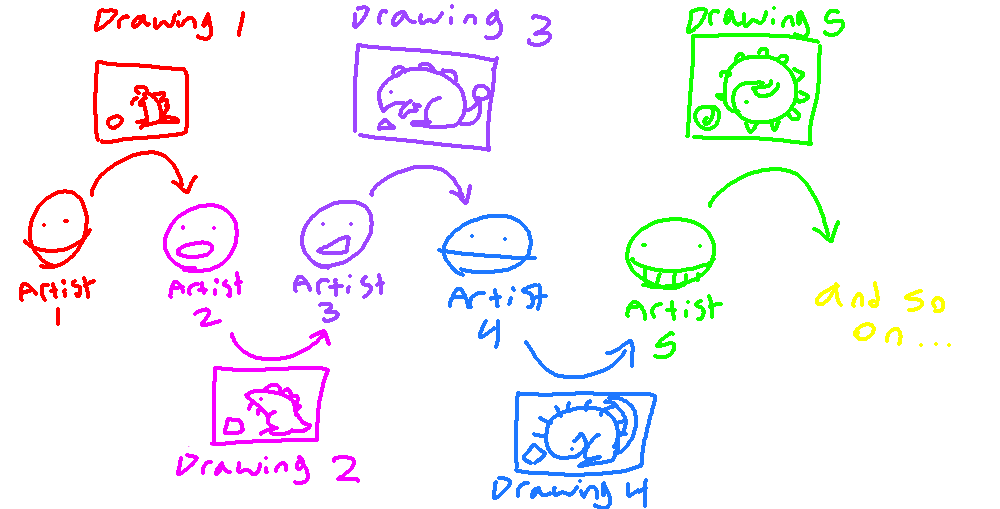
That's how I do it anyway. I've seen variations where the first artist sends their piece to someone who writes some kind of description of the piece, which is sent to the next artist, and then to another writer, another artist, and so on. This will obviously lead to even more drastically mutating art, if so desired.
Everything that follows is optional advice! If you read the above text box then you know everything you need to artphone. That said, having participated in a bunch of these, I do have a lot of thoughts on what I think makes for a successful game. Feel free to read or ignore any of the following. Most of the following is really only relevant if you end up with a large group of players and can be ignored if it's just you and a handful of friends playing.
HOW DO?
The game master - I'm sure it's possible to run a game in a decentralized manner, but I've always done it with one person responsible for the whole game who knows the artist order and acts as the go-between, shuttling the most recent drawing from one artist to the next. Much like in any other game that requires the role, the position of game master is best filled with by someone who's neurotic enough to keep track of all the players and make sure things keep moving, but not so neurotic as to be overbearing.
Number of artists - I think the ideal number of artists is around 10-20. Enough to ensure lots of change but not so many that scheduling becomes a nightmare. I have run extremely long chains of artists before but it wasn't easy!
Time limits - This is so important. Here's the thing about artists: most of us have at least one personality or spectrum disorder that often interfere with our ability to do non-urgent projects in a timely manner. Yes there are absolutely some extremely punctual and professional artists but many of us left to our own devices might take months to get around to finishing a piece for a game, and the longer it drags out the harder it's going to be to finish.
I've experimented a good deal with different time limits, and most of the past games I gave artists between 5 and 7 days to complete their art. Oftentimes as the deadline was coming up and they hadn't finished, I would accept a work-in-progress as at least something to pass along to the next artist, with the understanding that they'd finish their piece at and send me the final version at some point before the end of the game. In probably like 80% of the cases I still had to chase them down at the very 11th hour.
In my experience, the vast majority of artists would finish their piece either within the first 24 hours or at the last possible moment. To that end, I tried an experiment in early 2026 and ran a game where everyone had only 24 hours to finish their piece, no WIPs accepted except under extenuating circumstances. It worked great! There are some artists who absolutely need more than 24 hours for one reason or another but the vast majority were able to turn out art that was just as good as the longer deadline pieces and also didn't have time to overthink their piece. Speaking of which:
Art quality - one issue that bedevils so many artists is feeling the need to put out some spectacular showstopper of a piece, especially in groups with a lot of skilled artists. This often leads to paralysis, with the artist worrying that they're not showing off their skills enough, or not being creative enough in their interpretation, and they stall out or get too dispirited about their art and remove themselves from the game. Kill this voice in your head! It's no good! The number one goal is to make something and have fun with it! Every game of art telephone I remind the artists multiple times that their goal is not to make a portfolio piece. If they do have the time and energy to make a showstopper, that's awesome, but it is absolutely not an expectation.
That said, I do think it is useful to have some kind of baseline expectation for the art. I like to make sure every piece submitted has a minimum of some kind of environment or background and at least two characters/creatures/entities interacting in some way, otherwise the risk is that by the end of the game the drawing has devolved to a lone character floating in an abstract or white void. I've seen it happen and it's a little boring.
Scheduling artists - this is especially an issue in games with 24 hours per artist. I recommend that before the game begins you poll the artists for which days work especially well for their turns to fall on, and conversely which days absolutely don't work for them. Inevitably unforeseen things will come up so you should have contingencies in case an artist ends up not being able to go on their scheduled day. I'm often able to make things work just by shuffling around available artists, but it also helps to have a few back-bencher artists who aren't in the main queue but are around and available to hop in to replace someone who has to drop out.
Teams - If you do end up running a game with 20 or more artists, consider dividing them up into teams. This can be extra fun since if you have the same starter image being sent to multiple teams, you can see how wildly it diverges from a single starting point. I really like doing this when possible. You can also let the artists give themselves silly team names and be playfully competitive.
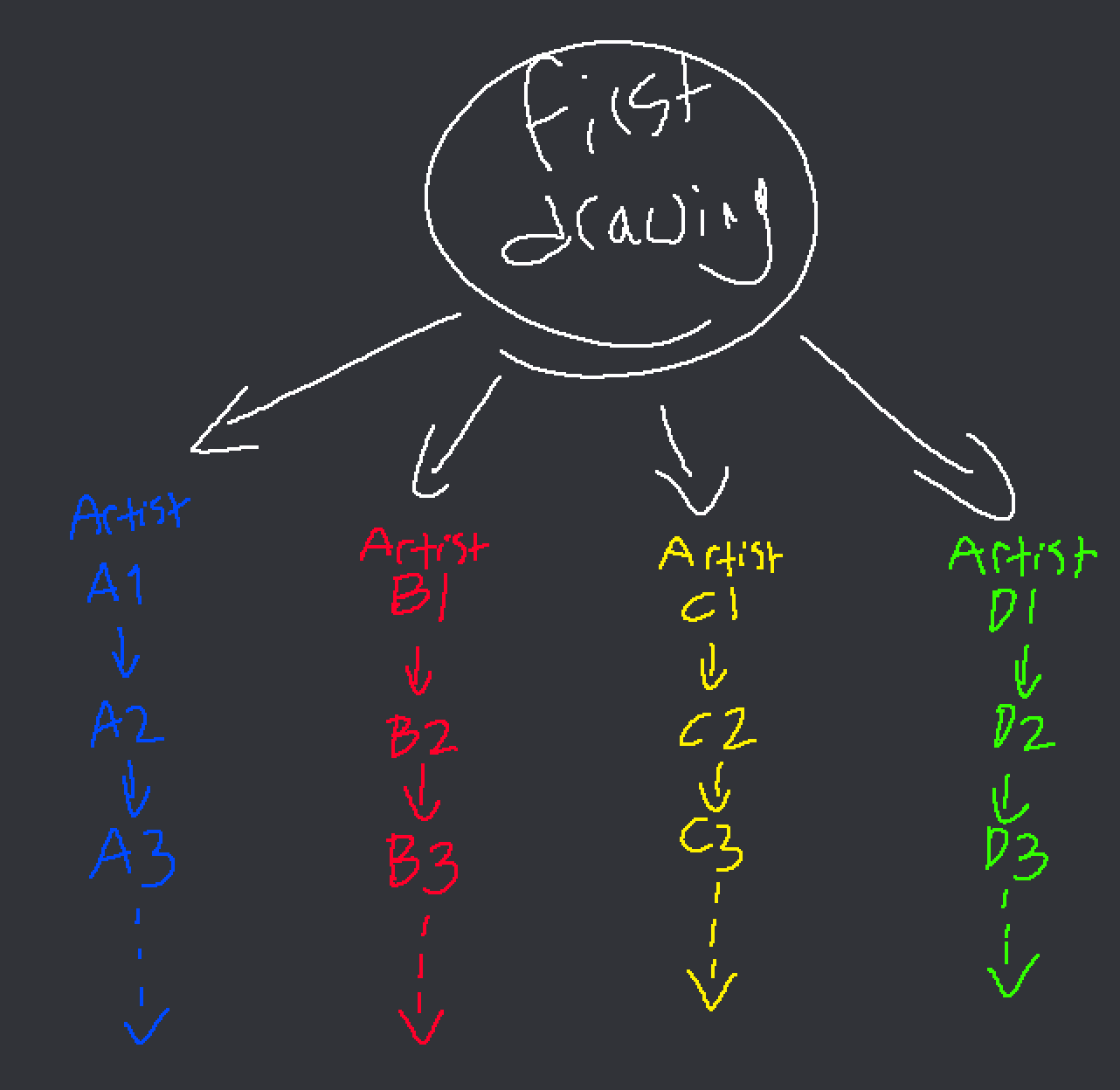
If you do run a game with teams like this, unless you have a lot of energy for wrangling multiple groups of artists simultaneously, I highly recommend deputizing one person per team as the team captain, who is then responsible for collecting and transferring art within their team and also passing it along to the gamemaster. I find it makes sense for the team captain to be the first artist in their team's order.
CAN I JOIN?
I get a lot of requests from people to join my art telephone games. I do really try and keep my games to just friends and friends-of-friends because I don't want things to get out of control and end up with a discord server full of 5000 rambunctious art teens or whatever. I can't deal with that shit! That said, if we're mutuals on social media that probably means I really dig your art and would be happy to have you in the group, just send me a message somewhere and I'll give you an invite. Of course there's a ton of cool artists out there that I don't follow because the internet is a vast place and I'm but one man, so if I don't follow you but you got a fun art style and can swing a 24-hour art challenge, feel free to contact me as well, but you absolutely cannot get mad at me if I say no.
Also! One of the reasons I wanted to make this page is to hopefully encourage other people to start their own art telephone games. It's really not that hard! Get some friends together and give it a shot! Even a small group of 5 or 6 artists can have a fun time!